
NEWS
News on end-of-life issues
February 6, 2026: New York Approves Medical Aid in Dying
February 6, 2026: Governor Kathy Hochul signed the Medical Aid in Dying Act today, making New York the 14th jurisdiction (13 states plus Washington D.C.) where MAID is legal.
This approval followed the actions of the Assembly and the Senate passing the underlying bill late last Spring. The Governor desired a number of changes to the bill that, in her view, would provide additional safeguards. The possibility of making these changes was negotiated with legislative leaders during the Fall.
The Assembly and Senate voted to accept these changes on February 4, paving the way for the Governor to sign the bill. MAID will begin operating this summer, giving time for the medical system to prepare and for the Department of Health to issue regulations.
The Changes
Compared with the bill passed last Spring, the new law will:
• Require that the initial evaluation of a patient by the attending physician be in person, unless the physician believes an in-person evaluation would result in extraordinary hardship to the patient.
• Require that a recording of the patient’s oral request to their physician be placed in their medical records.
• Require that the patient be a resident of New York.
• Require that the patient be evaluated by a mental health professional (a psychologist, psychiatrist, or neurologist), to determine whether the patient has decision-making capacity to make an informed decision.
• Require a waiting period of five days between when the physician writes a prescription and when the pharmacist fills it, unless the patient will die within that period.
• Ensure that a patient receiving hospice care at home is not prevented from accessing medical aid in dying, even if the hospice provider does not offer medical aid in dying based on its religious beliefs.
• Delay implementation of the law until six months after signing.
December 17, 2025: Governor Hochul to Sign NY Medical Aid in Dying Act
December 17, 2025: Gov. Kathy Hochul announced today that she would sign The Medical Aid in Dying Act, which will allow terminally ill New Yorkers to receive medical assistance to end their lives in specific situations.

The law will apply to adults who have incurable, irreversible illnesses and six months or less to live. Each patient will need the sign-off of three doctors. One of the doctors will be empowered to write a prescription for life-ending medication, which the patient must self-administer.
At a news conference about the legislation this afternoon, the Governor said she intends to sign the bill after the State Legislature returns for session in January and formally adopts a raft of changes she wants made to the original bill passed earlier this year
Governor Hochul, who is Catholic, said it was one of the most difficult decisions she had faced as governor. In an essay published this morning in the Albany Times Union, she said that she had listened to people suffering through the agony of a slow death, and that their painful experiences mirrored her own observations of a beloved family member.
The governor, a Democrat, said that she had struggled with Catholic teaching on the measure. “There’s a lot of religious conflict in me, the way I was raised,” she said on Wednesday. “But I realized it’s not about me, it’s about 20 million New Yorkers.”
If a suffering New Yorker made the difficult choice to die, she asked, “Who am I to stand in their way?”
June 9, 2025: Senate Passes Medical Aid in Dying Act
June 9, 2025: The New York State Senate passed the Medical Aid in Dying Act by a vote of 35 to 27 late this evening. Although passage was virtually assured in advance, the final vote could not be predicted.
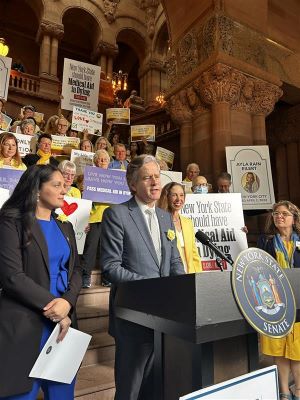
The day began with a gathering of advocates from around the state at a press conference. The bill’s Senate sponsor, Brad Hoylman-Sigal led the event. In the photo, Senator Jessica Scarcella-Spanton (the prime cosponsor) is on the left, and Assemblymember Amy Paulin (the sponsor in the Assembly) is just right of center. Campaign Director Corinne Carey is on the right.
The Senate’s session began at 2:30 PM, but consideration of the bill did not begin until about 7:00 PM. Advocates were present in both galleries overlooking the Senate floor, as were some members of an opposition group. The debate consisted mostly of Senators who opposed the bill asking pointed questions of Senator Hoylman-Sigal. This was followed by a voting period in which some Senators rose to explain their vote.
An official video of the session is available on Youtube HERE, beginning at time marker 2:15:20. Among local senators,
• Senator Ashby asked very pointed questions for more than 15 minutes, indicating that he would vote against the bill, beginning at 3:02:53
• Senator Tedisco explained some reasons why he was voting against the bill, beginning at 4:31:55
• Senator Fahy said that the decision was very difficult for her, and she explained why she voted for the bill, beginning at 4:34:10
The session ended with Senator Hoylman-Sigal, the bill sponsor, explaining his vote for the bill beginning at 4:45:13. This was immediately followed by the announcement of the count of the votes.
As in the Assembly, no Republicans voted for the bill — although several had indicated that they would. Six Democrats voted against the bill. Toward the end of the campaign, phone-banking operations involving advocates and staff targeted six or seven Senators whose support was uncertain. All but one of these Senators voted for the bill.
Having passed the Assembly on April 29, the bill — now officially referred to by the Assembly number (A.136) — will eventually be sent to and received by the Governor. The process by which the Governor considers whether to sign the bill, or not, is governed by formal rules and less-formal procedures.
As written, the bill will become law and go into effect as soon as the Governor signs the bill. Knowledgeable observers think that this will happen much later in the year.
May 20, 2025: Delaware Enacts Medical Aid in Dying
May 20, 2025: Governor Matt Meyer signed the “Ron Silverio/Heather Block End of Life Options Act” into law today, making Delaware the 12th jurisdiction to legalize medical aid in dying. The House and Senate had passed the legislation earlier this Spring. The new law will go into effect Jan. 1, 2026 at the latest, unless the required regulations can be promulgated sooner.
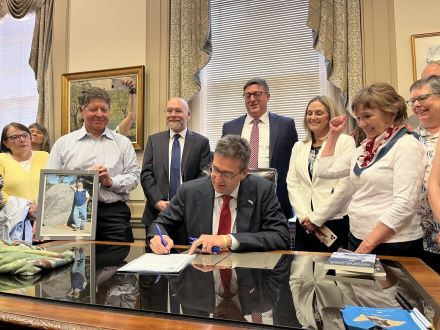
Gov Meyer said “This signing today is about relieving suffering and giving families the comfort of knowing that their loved one was able to pass on their own terms without unnecessary pain and surrounded by the people they love the most”.
Last year the same bill was approved by the legislature also, only to vetoed by the former governor.
April 29, 2025: Assembly Passes Medical Aid in Dying
April 29, 2025: The New York State Assembly passed the Medical Aid in Dying Act (A136) Tuesday by a vote of 87–61, the last step of a two-day process. On Monday, the bill was taken up by both the Health Committee and the Codes committee, passing both.
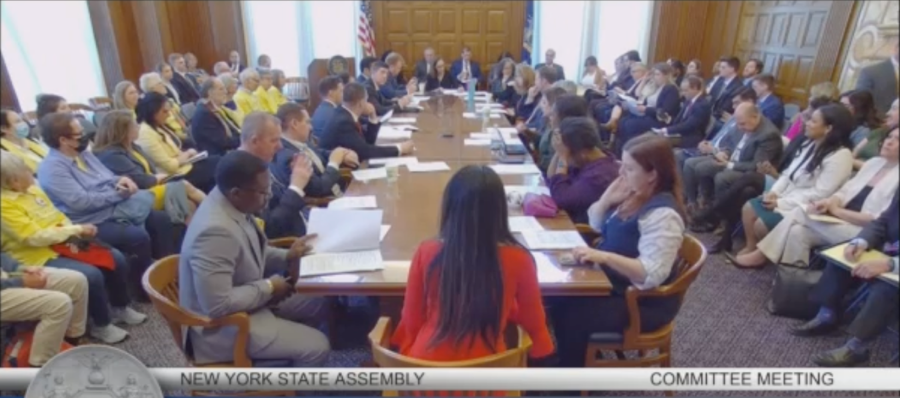
On Tuesday morning, the bill sponsors held a press conference, while the Rules Committee passed the bill and sent it to the floor.
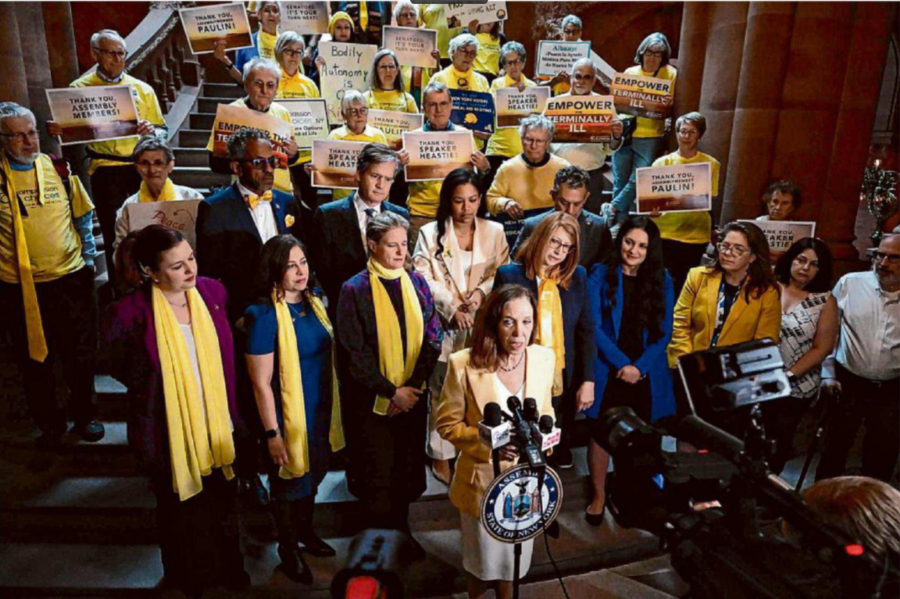
The Assembly began considering the bill shortly after noon. Debate lasted nearly five hours, with yellow-shirted advocates glued to their seats in the gallery.
The nature of the debate was this: individual legislators would pose questions to the bill sponsor, Amy Paulin. Legislators supporting the bill tended to ask questions whose answers outlined the general benefits, features, and safeguards in the bill. Opponents asked detailed questions about features that they thought were inadequate or would have objectionable results. After a series of questions and answers, the legislator would switch to stating their assessment of the bill and how they planned to vote.
The voting began, with legislators casting their votes electronically from their seats. During this process, some legislators took floor time to explain the reasons for their vote. A surprise at the end was that five legislators were allowed to cast their vote by videoconference.
In the greater Capital region, most Democrats voted in favor: Assemblymembers Barrett, McDonald, Romero, Shrestha, Steck, and Woerner. Assemblymember Santabarbara voted against the bill.
No Republicans voted in favor of the bill, despite the fact that several had indicated that they would vote in favor. It seems as though the Republican leadership demanded that their members vote against the bill.
Thank you, Mr. Speaker
At the beginning of last year, it seemed as though Speaker Carl Heastie was blocking the bill from moving forward. As the campaign unfolded this year, Speaker Heastie was acting more favorably. He became a champion of the bill, and without his special efforts the bill would not have come up and passed.
January 14, 2025: Campaign Kickoff and Lobby Day
January 14, 2025: Advocates from around the state came to the Capitol today for the Kick Off of the 2025 campaign to enact the Medical Aid in Dying Act. They first gathered in the Legislative Office Building, and small groups delivered information to legislators’ offices, talking with legislators and staff when possible.
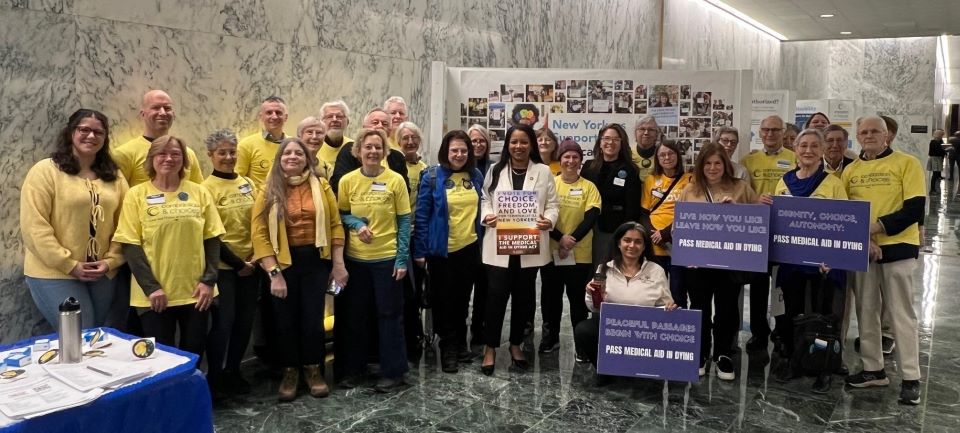
Today was also the day of the Governor’s State of the State address, held in the Egg. Advocates moved to the Concourse in the Empire State Plaza, to show our presence to all the legislators as they walked by. Along with people from other groups, the medical-aid-in-dying group was permitted only on one side of hallway.
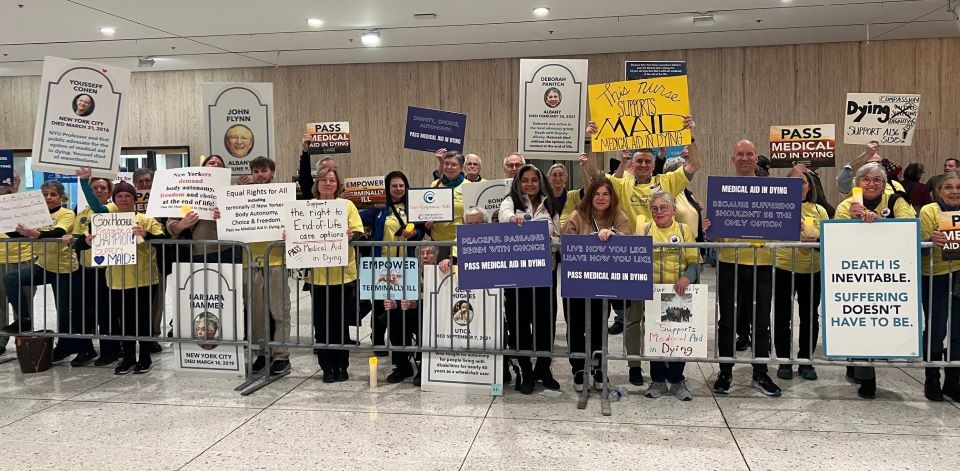
Despite a noisy and hectic situation, some lawmakers stopped to greet the advocates and others waved as they passed by.
November 29, 2024: End of Life Bill in the U.K.
November 29 2024: The British House of Commons approved an end-of-life bill for England and Wales on its second reading, 330–275. The bill still needs to pass through committees and other steps to achieve final approval. Interestingly, the bill was submitted as a private members bill, not by a government minister. Only by good luck in a random drawing was it chosen to receive a full debate and vote.

Two key features of the bill make it similar to medical-aid-in-dying laws in the U.S. — and different from related laws in Canada, Belgium, and the Netherlands. These are: (1) to be eligible, a patient must be expected to die within six months, and (2) the patient must self-administer the provided substance. However, the procedure is more complicated than in the U.S., with every case required to be reviewed by a judge.
Especially interesting is how the assistance is to be provided under the law. Rather than being based on medication only, there will be a list of “approved substances” that may be used. The list, which is to be specified by government regulations, may include “drugs and other substances”.
The law requires a doctor to be present during the assisted death. The doctor may “prepare a medical device which will enable that person to self-administer the substance” and may “assist that person to ingest or otherwise self-administer the substance”.
The law is clear that ingestion is not the only possible method of self-administering the substance. Thus, intravenous self-administration of a lethal drug (which is an established practice in Switzerland) seems to be well within the vision of the law. Other methods that exist or may be developed may also be available.
News Archive
The archive has older news items.